
San Joaquin County City Directory Years
The strongest verified run is the San Joaquin County city and county directory collection at the Historical Museum at Micke Grove Regional Park. The aggregate span is known, but an official online shelf list does not expose each publisher, title, or volume year. That distinction matters: a search plan can use the verified range without inventing a missing issue or assigning a publisher that still needs confirmation.
| Collection | Years | Where Held | Access |
|---|---|---|---|
| City and county directories | 1852 to 1980 | Historical Museum | Appointment only; confirm title and publisher by volume |
| Official county archives | 1850 to 1990 | Historical Museum | Appointment research; assessment, plat, planning, vital, and registry material |
| Maps and aerial photographs | 1860 to 1990 | Historical Museum | Appointment research; local maps, Sanborn maps, and aerial context |
| Stockton newspapers | From 1850, nearly complete | Chavez Central | Microfilm viewing, printing, email, or USB save |
| City, telephone directories, and yearbooks | Local runs; exact volume list not online | Chavez Central | Second-floor Local History and Genealogy Collection |
| 1895 Stockton Sanborn atlas | 1895, 85 sheets | Library of Congress | Free digital images and public-domain access |
The table separates a directory shelf from the county archive around it. A city directory can supply names and addresses, while the archive can supply assessment or plat context and the newspaper file can test a death notice or move. Those sources answer different questions even when they describe the same address.
Where San Joaquin County Directory Shelves Are
The Historical Museum at Micke Grove Regional Park is at 11793 N. Micke Grove Road, Lodi. Its Gerald D. Kennedy Reference Library and archives are non-circulating. Research is by appointment only, and walk-ins are not accommodated. Call 209-331-2055 or email info@sanjoaquinhistory.org before planning a directory visit. Ask for the shelf list, the exact volume title, and the abbreviation pages for the years needed.
Historical Museum Archives
1850 to 1990 official county archives, 1852 to 1980 city and county directories, school yearbooks, maps, photographs, and historical registers.
209-331-2055
info@sanjoaquinhistory.org
Appointment only
Chavez Central Library
605 N. El Dorado Street, Stockton. The second-floor, non-circulating Local History and Genealogy Collection emphasizes Stockton and San Joaquin County.
Microfilm and staff inquiry are available in the library.
Chavez Central reports more than 1,500 genealogy reference books and 175 genealogy magazines. Its collection policy confirms county city directories, telephone directories, and high-school yearbooks. The exact local run is not posted online, so a staff question is the right way to locate a volume rather than assuming that every year is present.
Use the Historical Museum archives description for the appointment route and holdings. The Chavez collection policy explains the library’s local-history scope and why the shelves are a companion to, not a substitute for, the museum archive.
Read San Joaquin County Directory Entries
A Stockton city directory entry should be read with its abbreviation page beside it. A digitized Stockton directory sample is available through the Golden Nugget Library PDF; use the title matter and abbreviations as evidence about that volume, not as proof of the full 1852 to 1980 run. A normal alphabetical entry may include a surname, given name or initial, spouse in parentheses, widow notation, occupation, residence address, business address, and marks such as homeowner, householder, rooms, or boards.
| Name line | Surname and given name or initial; spouse may appear in parentheses. |
|---|---|
| Family notation | Widow wording and other publisher marks can help separate people with the same name. |
| Occupation | The historical occupation field is a clue for distinguishing one household from another. |
| Address lines | Residence and business addresses may both appear; copy street spelling and numbers exactly. |
| Household marks | Homeowner, householder, rooms, and boards symbols require the volume’s own abbreviation key. |
Directory data records a publisher’s canvass date. It does not prove continuous occupancy between editions. Initials can change, spellings can vary, and a person can disappear without a clear reason. A later newspaper, probate file, deed, or census schedule may explain the gap.
Alphabetical and Criss-Cross Sections
The alphabetical section answers a name-first question. The street or criss-cross section reverses that route, letting a researcher start with a house number and street and then list the names the publisher placed there. A classified section groups businesses or trades. These sections should be read together when a family name is uncertain or when an address is the only surviving clue.
- Criss-cross directory
- An address-ordered directory section that turns a street and number into the occupants or listings recorded by that publisher.
- Householder index
- An index organized around the person treated as the household head, useful for moving from a household clue to a name entry.
- Abbreviation key
- The volume’s explanation of shortened words and symbols. Record it before interpreting marks in an entry.
Do not treat a criss-cross line as a deed record. It is a directory observation made for a particular edition. The result may show a listed occupant, a business, or a household marker while leaving ownership unresolved.
Trace San Joaquin County Directory Households
Family-history work is strongest when each directory entry is copied before it is interpreted. Start with a person, record the exact line, then use the address and street section to locate related names. Move through nearby volumes instead of treating one edition as a complete account of a household.
- Find the person in the alphabetical section and transcribe the name, spouse notation, occupation, address, and abbreviations.
- Check the street or criss-cross section for other names recorded at the same address.
- Move one volume earlier and one later, noting each address change and any shift in initials or spelling.
- Use an occupation change, a spouse name, or a street move to separate people with the same name.
- Pair directory years from 1900 through 1950 with the matching decennial census schedules.
- When a name vanishes, test death notices, probate, deed or mailing data, relocation, and spelling variants.
The latest public federal population schedule is the 1950 census as of 2026 under the 72-year rule; the 1960 census becomes public in 2032. The census fills household and relationship gaps, while the city directory supplies address detail between decennial snapshots.
Note: A directory disappearance can mean a move, death, omission, or spelling change, so one missing year is not a conclusion.
San Joaquin County Record-Keeping Timeline
San Joaquin County’s record history has separate starting points. County archives, recorded instruments, newspapers, directories, maps, and public census schedules do not begin in the same year. Keeping those dates distinct prevents a directory search from being mistaken for a complete county record search.
| Point in time | What the record history adds |
|---|---|
| 1850 | San Joaquin County was one of California’s original counties; official county archives and Stockton newspaper holdings begin in this research record. |
| 1851 | Recorder research reaches recorded instruments from this year forward. |
| 1852 | The verified city and county directory span begins at the Historical Museum. |
| 1895 | The Stockton Sanborn atlas provides 85 sheets of street and building context. |
| 1950 | The latest public federal population schedule as of 2026 supplies household comparisons. |
| 1980 | The verified Historical Museum directory span ends; later local runs need shelf confirmation. |
| 1990 | The official archive and map or aerial holdings reach this endpoint in the research record. |
The San Joaquin County election statistics database adds a searchable civic-history reference that helps place a person or community in the county’s public record landscape.
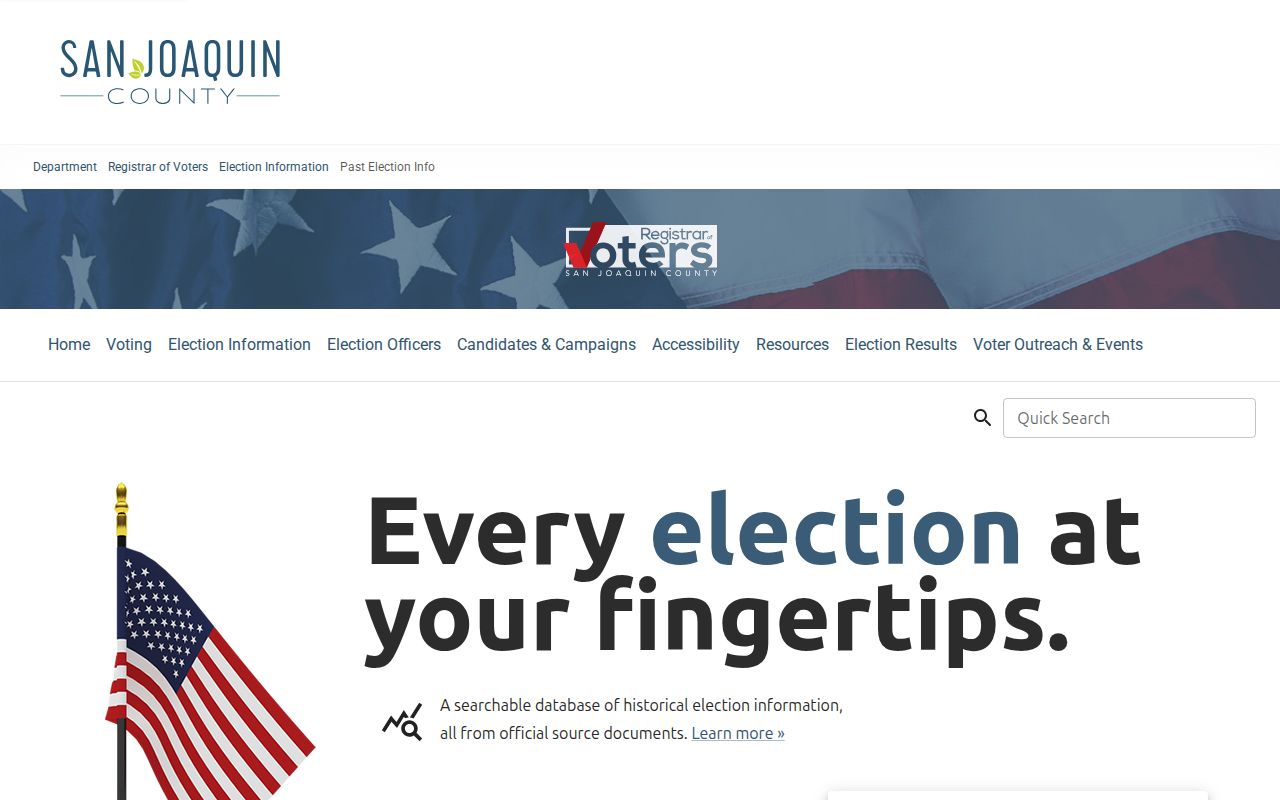
Election statistics provide civic and geographic context, not a current resident list, so they belong beside the directory and archive evidence.
Note: The 1850 archive start and 1851 Recorder start are different facts and should remain separate in a San Joaquin County city directory citation.
San Joaquin County Newspaper Records
Chavez Central Library, 605 N. El Dorado Street in Stockton, holds Stockton newspapers from 1850 and describes the run as nearly complete on microfilm. Images can be viewed, printed, emailed, or saved to USB. A subject index covers many, but not all, years, so an index miss is a reason to ask staff about the microfilm sequence rather than a reason to stop searching.
The library also provides an obituary and vital-notice copy-request service. An obituary can connect a former address to relatives, a spouse, a later residence, or an estate clue. Use the notice as a lead and compare names, dates, and addresses with the directory entry. The Chavez Local History and Genealogy page is the access point for the collection and its services.
Note: Chavez Central supplies research access copies, while certified county records remain with the appropriate public custodian.
San Joaquin County Community Records
Printed city directories do not capture every community or every naming style. The Historical Museum’s related collections add human-use paths for classmates, relatives, and local groups. Eight named school yearbook collections cover Stockton, Lodi, Tokay, Ripon, Tracy, Lincoln, St. Mary’s, and Edison. They can connect maiden names, clubs, classmates, and school activities to a dated person clue.
- University of the Pacific’s Holt-Atherton Special Collections and Archives holds regional manuscripts, photographs, and university history; current catalog guides should be checked for access.
- Manila Club and Hotel corporate records document a social organization and residential hotel central to Stockton’s Little Manila.
- Chinese-language business records from 1879 to 1933 can preserve names under transliterations that English indexes miss.
- First Families of San Joaquin, formerly the Pioneer Registry, provides a direct genealogical collection.
- Immigrant-community photographs, reclamation records from 1862 to 1980, and Online Archive of California finding aids for more than 100 museum collections broaden the trail beyond printed directories.
Other museum holdings include the Weber family business and personal papers, Tillie Lewis papers, and photographs of East Asian, Sikh, Filipino, Latin-American, and Southern European farm-labor communities. Reclamation records can place a Delta resident in an island, district, or rural-route setting when a numbered street never appears.
These materials explain why a search should account for Spanish compound surnames, married and maiden forms, Asian name order, transliteration variants, initials, and diacritics. Search the historical spelling first, then test the modern form. A directory result that needs current-record verification can move to the San Joaquin County resident lookup; modern address-keyed work belongs with the San Joaquin County street directory.